You can get about 10 months of Netflix, 200 packages of ramen, or two - three oil changes, if you have a 1935 Lincoln Penny!
All of that for a single penny? Yes, that’s true!
If you have a high-grade 1935 Lincoln (wheat) penny, that you are one sale short of a fortune. If it comes with an error, then that’s a treasure!
Let’s dive deeper into understanding the 1935 Wheat penny value, its determinants, and history! With this article, you can facilitate the optimal price for your coin by having strong negotiation points!
The rather fascinating history of the 1935 Wheat penny is an incomplete quest of Augustus Saint-Gaudens completed by Victor David Brenner. Saint-Gaudens was commissioned with the redesign for four gold coins and the cent. However, he passed away before submitting the designs for the cent.
This task was undertaken by Brenner after the urges of President Franklin Roosevelt for redesigns of the US coins. Thus, came into existence was the Lincoln (wheat) penny commemorating President Abraham Lincoln’s centennial birth anniversary.
The cent was named after the reverse design that depicted two wheat ears that were a nation-wide symbol of abundance.
The Lincoln Penny or the Wheat Penny became a symbol of American coinage being introduced in 1909 and minted until 1958, the year when the reverse was changed.

It's necessary that you know the features of the 1935 Wheat penny for authentication and personal knowledge.
Condition is among the major determinants of the 1935 Lincoln (wheat) penny value along with mintmark and errors. The condition corresponds with the grading scale while being categorized into four types.
Here is a summarising table depicting the coin value based on condition:
| 1935 Lincoln Penny Value | ||||
|---|---|---|---|---|
| Date | Condition of Coin | |||
| Good | Fine | Extremely Fine | Uncirculated | |
| 1935 | $0.06 | $0.11 | $0.20 | $4 |
| 1935 D | $0.08 | $0.15 | $0.43 | $6 |
| 1935 S | $0.08 | $0.24 | $0.45 | $8 |
| 1935 Lincoln Penny Value Up-Dated | 2025 | |||
Like the coin condition, the mintmarks on the pennies also play a significant role in influencing the coin value. The 1935 wheat penny was struck at three US Mint facilities: Philadelphia, Denver, and San Francisco.
The wheat pennies are possible to find in brown, red-brown, and red varieties in most grades. The mint mark on the pennies are engraved on the obverse under the year imprint.
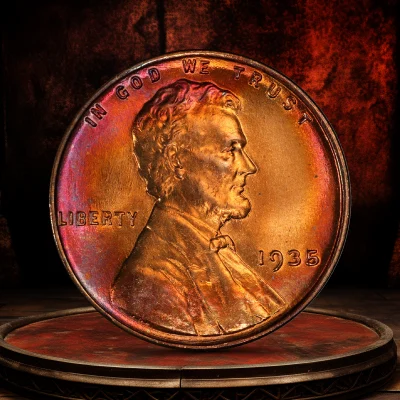
The 1935 Wheat pennies that lack the minmark are minted in the Philadelphia Mint. A total number of 245,388,000 pennies were struck here. Due to such a high mintage, these coins are widely available despite being old.
A circulated brown coin would fetch values from $0.05 to $2, while circulated pennies could go from $15 to $25 for higher grades. Furthermore, the fully red coins with grades as high as MS68 can fetch up to $8,000.
In 2022, a no-mint mark 1935 wheat penny was sold at a staggering $55,813 at the Legend Rare Coins Auctions.

The D mint mark is engraved on the pennies that are struck at the Denver facility of the US Mint. A total number of 47,000,000 pennies were struck here, where many pennies were not-well struck since the mint still used old dies. Similar to the Philadelphia minted coins, high mintage lowers the brand value.
The 1935-D wheat pennies in brown shade are worth from $0.10 to $2.75 in circulated condition. The uncirculated coins start their valuation from $50 for the MS65 grade, but the value shoots up for MS68 grade priced at $13,000.
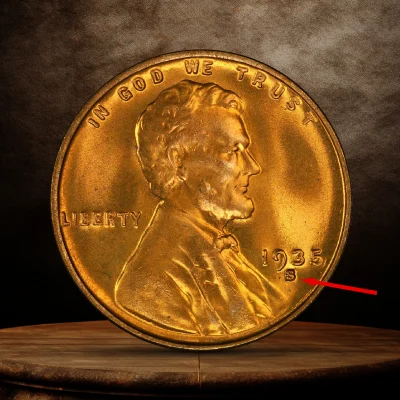
The 1935-S mint mark pennies are struck at San Francisco with mintage of 38,702,000, the lowest of the three. The San Francisco minted pennies are pretty common and available in all grades. It's ideal if you find a penny in pristine condition, for higher prices.
Circulated condition 1935-S Lincoln pennies are valued from $0.10 to $6.50, while the uncirculated coins can go up to $90 (this will get you your Netflix!) For higher grades like MS67, the 1935 wheat penny value at be at least $7,500.
Now that conditions and mintmark are done, the third deciding component of the 1935 Lincoln penny value is Error. Errors are simply the manufacturing defects from the mints that increase the value instead of devaluing it.
Here are the top 3 errors of the penny that matter:

The double die error as the moniker, is an error that depicts double imprinted designs by the same working die. This error can occur on the obverse or the reverse. This particular error - Double Die Obverse, is on the obverse visible around Lincoln’s beard, date, and the motto.
The 1935 wheat penny with this error can fetch values up to $80, but can increase depending on condition and mintmark.

Off center errors are the errors where the planchet and striking die are misaligned. As a result, the design is off struck leaving a part of the coin blank. The off-center is measured by the percentage such as 10% off-center, or 50% off-center.
This error is quite popular among collectors as it is pretty uncommon. The 1935 Wheat penny with an off-center error can fetch up to $50.
The repunched mint mark is a variant error of the repunched errors which can also include repunched dates. This error originated in the pre-1990s, since the mint marks were individually punched on the die by hand. This led to humanely misalignment with each mint mark, and were resolved with a repunch.
This error is also quite popular among collectors in the Lincoln penny series that fetch values from $3 to as high as $10. This value will increase if the coin is in pristine condition.
Determining the authenticity of the 1935 Lincoln penny includes knowing about the correspondence of grading scale and the conditions. The grading scale is a scale developed by globally renowned coin grading services like Numismatic Guaranty Company (NGC) and Professional Coin Grading Service (PCGS).
This table below will help you:
| Grading Scale | Condition |
|---|---|
| 1 | Basal State - 1 |
| 2 | Fair |
| 3 | Very Fair |
| 4, 5, 6 | Good (G) |
| 7, 8, 10 | Very Good (VG) |
| 12, 15 | Fine (F) |
| 20, 30 | Very Fine (VF) |
| 40 | Extremely Fine (XF) |
| 50 | About Uncirculated (AU) |
| 60 | Mint State (MS) / Uncirculated (BU) |
| 65 | Mint State (MS) / Uncirculated (BU) |
| 70 | Mint State (MS) / Uncirculated (BU) |
Well, that’s everything about the 1935 Lincoln (wheat) penny you need to know to find the optimal prices for the penny. If you happen to find a Lincoln penny in your attic or your grandparents house, then your fortune is a few steps away.
Now with this article, you can negotiate for the prices for the penny instead of wondering is this penny even worth something! To sell this coin, you can explore local buyers, or online auctions for better prices. It's recommended to get your penny appraised from the coin grading service.
The US Mint has produced such coins repeatedly throughout history such as the Morgan silver dollars, Gold Buffalos, and modern silver coins. Explore BOLD for more such coins at very competitive prices!



Affiliations


Copyright BOLD Precious Metals 2026