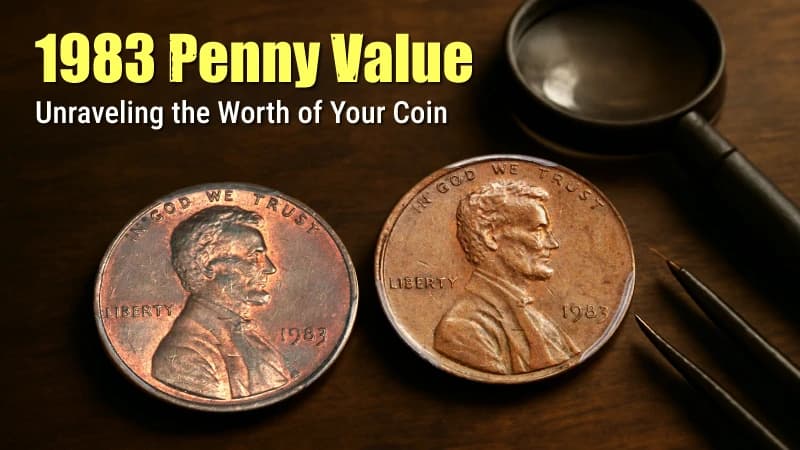
The 1983 Lincoln penny appears to be a normal one, but some are secretly
valuable. Although most won't be worth more than a cent, some, such as
rare mint mistakes like doubled dies or copper planchets, can fetch
hundreds or thousands of dollars. Condition, mint mark, and metal all
significantly contribute to their value.
Knowledge of these factors can enable collectors to find a secret treasure
in common change. So, don't let that penny slip away—it could be worth
more than you know!
Key Takeaways
-
Weigh it Accurately: A weight of around 3.1 grams indicates a
rare copper planchet error; regular pennies weigh around 2.5 grams.
-
Check the Mint Mark Carefully: "S" is San Francisco proof, "D"
is Denver, and no mint mark is Philadelphia—each affects value.
-
Examine Diligently for Errors: Double dies, off-center strikes,
or other minting flaws under magnification.
-
Grade Overall Condition: More valuable are generally
higher-grade, uncirculated coins.
-
Have a Professional Opinion When in Doubt: For error or rarity
discoveries, have professional grading determine authenticity and
market value.
The Standard 1983 Penny: Composition is Key –
Copper-Plated Zinc Planchets
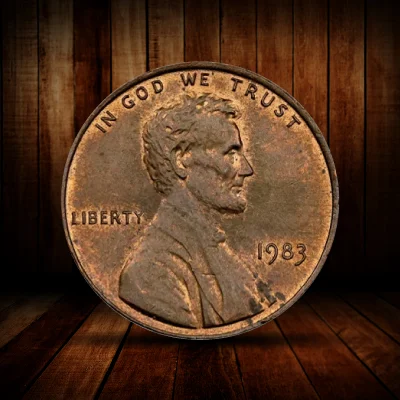
Before 1982, American pennies consisted of a bronze planchet—a generic
name for a copper planchet—that was 95% copper and 5% zinc or tin. But
as copper became more expensive, the U.S. Mint changed in 1982 to an
inferior version: a 97.5% zinc core with 2.5% copper plating.
Consequently, all 1983 pennies were intentionally produced to be
minted on just these zinc planchets coated with copper. These regular
1983 pennies typically weigh 2.5 grams, and the ones in general
circulation and with wear marks typically contain only the face value
of one cent.
Even copper-plated zinc pennies that are not circulated from 1983,
when in mint-state, like-new condition (graded MS-65 or better),
usually command only a small premium. Based on luster, strike, and
appearance, their price can vary from $0.30 to a few dollars. Any
variation from the normal composition or design, however, can indicate
a coin printed highly collectible, rare error.
The Star of the Show: The Exceedingly Rare 1983
Solid Copper Penny Error
This is where it gets interesting for collectors—some 1983 pennies were
accidentally struck on remaining solid copper planchets from before 1982.
These errors are actually quite desirable because of their composition and
rarity.
Why they're important:
- Mint error: Struck onto 95% copper planchets rather than zinc.
- Rarity: Few known to exist.
- Value: Can sell for thousands if graded.
To find one is like winning the lottery—a coin valuable that looks normal
but is anything but!
How to Identify a Potential 1983 Copper Penny:
Critical Checks
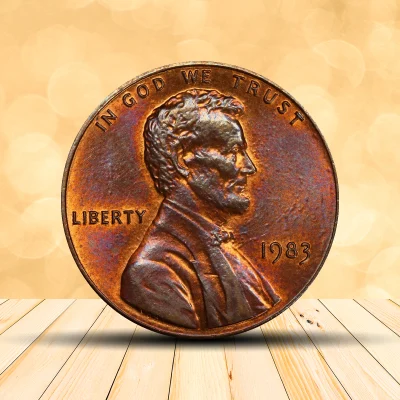
To locate a possible 1983 copper penny needs careful examination is
needed. The following are the main ways:
Coin Weight: This is the most important and final test. The
first thing that any individual should ever do for an initial check is
weigh the coin precisely. A real 1983 copper penny will weigh around
3.1 grams. That is a lot more than the 2.5 grams of a common zinc
penny. The requirement in this case is a solid digital scale that can
at least read to two decimal places.
Sound Test (Less Accurate): Certain veteran collectors claim
that real copper pennies have a clearer, more ringing sound when
dropped carefully onto a hard surface than the dull, flat-sounding
zinc pennies. The test is extremely subjective and less reliable than
the exact coin weight test.
If you happen to believe that you have an authentic 1983 copper penny,
it is absolutely important that it is professionally graded and
guaranteed by an independent grading service like PCGS (Professional
Coin Grading Service) or NGC (Numismatic Guaranty Corporation). It is
advisable to confirm that the coin is genuine because the incredibly
high value of such error coins can result in the fact that false coins
being in circulation.
If you happen to believe that you have an authentic 1983 copper penny,
it is absolutely important that it is professionally graded and
guaranteed by an independent grading service like PCGS (Professional
Coin Grading Service) or NGC (Numismatic Guaranty Corporation). It is
advisable to confirm that the coin is genuine because the incredibly
high value of such error coins can result in the fact that false coins
being in circulation.
Mint Marks and Their Influence on 1983 Penny Face
Value
The United States Mint, or US Mint, is the government institution that
produces all coins legal tender in the USA at a number of production
plants.
The mint mark penny, usually an oftentimes small letter on the obverse
(front of the coin, usually under the date on a Lincoln cent), indicates
the coin's location of manufacture at the US Mint. The mint mark penny is
one of the most significant determining factors in the evaluation of
collectors when deciding on a coin's rarity and value.
-
No Mint Mark (Philadelphia Mint): No mint mark on the 1983 penny
is an indication that it was minted at the Philadelphia Mint. Normal
1983 Philadelphia zinc pennies are not valuable other than in high
uncirculated grades or for known minting defects.
-
"D" Mint Mark (Denver Mint): Small "D" below the date shows that
it was produced at the Denver Mint. Like the Philadelphia coin,
circulated 1983-D pennies are typically face value, but uncirculated
coins graded MS-67 and higher are worth more.
-
"S" Mint Mark (San Francisco Mint): San Francisco only minted
proof pennies in 1983, which were collector coins. They are mirror
finish with sharp detail. They are only worth a few dollars for each
coin, but a copper 1983-S proof—if found—would be priceless.
The Allure of Error Coins: Beyond the Copper
Transitional Rarity – Mistakes Worth Money
Besides the famous 1983 copper penny error, other types of minting errors
can also substantially increase a 1983 penny’s value. Collectors should
always be on the lookout for these potentially valuable coins:
Doubled Die Reverse/obverse (DDO/DDR)
This variety is where the die that makes contact with the coin itself
becomes double-impressed. Perhaps the most prominent one for 1983 is the
Doubled Die Reverse (DDR). On these pennies, words on the reverse
side—namely, "E PLURIBUS UNUM" and "ONE CENT"—are easily doubled on
viewing. The definition and depth of the doubling significantly affect the
coin's value.
An honest, mint-conditioned 1983 Doubled Die Reverse (DDR) can be worth
several thousand. Double-dies exist where the doubling is minimal and
design elements are noticeably off-center or have a bad secondary outline.
These are produced during the creation of the dies and can turn an
otherwise uninteresting coin into a valuable and unique piece for
sharp-eyed collectors.
Off-Center Strikes
This is an error where the bronze planchet or copper-plated zinc planchet
is not centered in relation to the dies upon striking. This causes some
portion of the picture to be missing. The more off-center the strike (but
hopefully still with the full date and mint mark), the nicer it will be
for specialty error coin collectors.
Clipped copper Planchets
It is a flaw wherein there is a clipped segment of the metal planchet,
normally a curve or straight clip. It is caused by improper feeding of the
planchet strip during blanking.
Die Cracks/Chips/Breaks
Since the dies used to strike steel get worn out due to multiple blows at
high pressure, they can acquire cracks, chips, or breaks. These defects in
the dies then get imprinted on the surface of coins struck with them and
can be seen as bumps or ridges.
These doubling mint errors, depending on how severe and how rare, can make
a coin worth several times more money than its intrinsic metal content or
face value.
It is to be added that not all visual errors are of consequence to be
major errors that dramatically boost the value of the 1983 penny. For
instance, while there is much hype about "small date" versus "large date"
for some dates of Lincoln cents (such as 1982), the 1983 penny lacks such
a well-known or popular major variety. Always verify error coins through
an expert or credible sources.
Condition (Grade) is Paramount for Determining
Coin Valuey
Regardless of whether your 1983 penny is a standard zinc coin, a rare
copper transitional error, or another type of error coin, its physical
condition (or grade) plays an absolutely crucial role in determining its
ultimate value.
A professional evaluation from a trusted coin dealer or third-party
grading service will meticulously assess this. Sometimes, a clear,
high-resolution picture can help in preliminary assessments before you
decide to sell or seek formal grading. Grading provides a universal
standard for a coin's state of preservation.
-
Circulated Coins: Coins that possess obvious evidence of usage in
commerce. The more wear and tear, the lower the grade attained and
consequently the less value.
-
Uncirculated Coins (Mint State): Coins with no indication of wear
and remain with their original mint luster as if newly issued by the US
Mint. These are the Memorial reverse cents (for the classic Lincoln
Memorial type on the back of the Lincoln cent 1959-2008) that serious
collectors are seeking in good condition. Mint State grades higher
(e.g., MS-65, MS-67, MS-68 on a scale of 1-70) are of finer preservation
and more valuable.
A well-publicized 1983 copper penny was reportedly sold at a major auction
in October for a high price, clearly demonstrating the significant
real-world value these rare coins can achieve in the numismatic market
when authenticated and graded.
Conclusion
While nearly all the circulating 1983 pennies are copper-coated zinc
coins only worth a cent, exceptions like solid copper type or doubled
die reverse error make it worthwhile to inspect each coin.
Transitional works and the rare mistakes are worth money to collectors,
and their value is in the thousands. Monitoring auction sales or places
such as eBay will help serious collectors estimate possible finds as
well as observe trends within the market.
BOLD's upfront pricing, lowest prices, portfolio options, and excellent
customer service—along with speedy shipping—make it collectors' go-to
partner to shop the numismatic marketplace conveniently and easily both
when buying and holding coin investments.