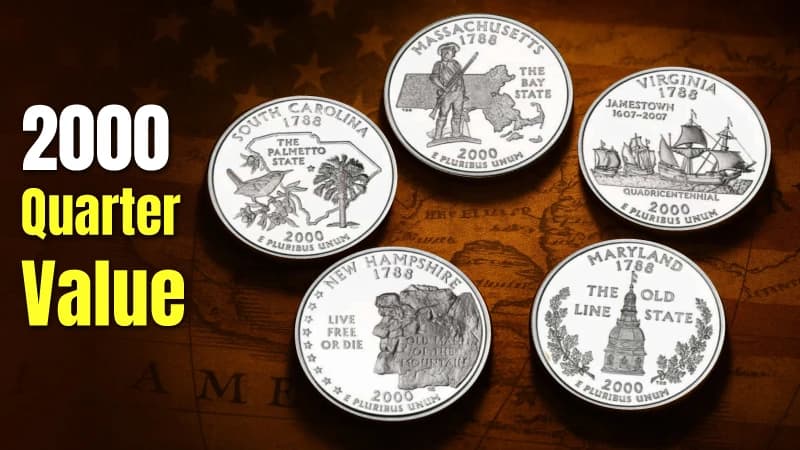
The 2000 quarter is the state quarters issued in the year 2000 as part of the U.S. Mint 50 State Quarters Program. This widely-known decade-long program (1999-2008) provided individual designs on the reverse of each quarter, in the order in which the state ratified the Constitution. There were quarters issued by the Mint for Massachusetts, Maryland, South Carolina, New Hampshire, and Virginia in 2000 alone.
So, what about their value?
These newer coins, although of value because of history and themes, are valued according to condition, mint mark, and scarcity, which are important to the collector. If you enjoy collecting coins, browse silver coins for sale at BOLD. Overall, the vast majority of 2000 quarters in common circulation are just face value (~$0.25).
The 2000 quarter is the state quarters issued in the year 2000 as part of the U.S. Mint 50 State Quarters Program. This widely-known decade-long program (1999-2008) provided individual designs on the reverse of each quarter, in the order in which the state ratified the Constitution. There were quarters issued by the Mint for Massachusetts, Maryland, South Carolina, New Hampshire, and Virginia in 2000 alone.
So, what about their value?
These newer coins, although of value because of history and themes, are valued according to condition, mint mark, and scarcity, which are important to the collector. If you enjoy collecting coins, browse silver coins for sale at BOLD. Overall, the vast majority of 2000 quarters in common circulation are just face value (~$0.25).
Simply put, Any state quarter produced in 2000 is called the 2000 quarter. These coins were issued as a series of the U.S. Mint 50 State Quarters Program (19992008) that issued each year five different state designs. The five states that were recognized were Massachusetts, Maryland, South Carolina, New Hampshire, and Virginia in 2000. All coins have the same obverse issue: the standard Washington image, and the reverse (tails) side has a state-themed issue.
What makes them unique, you ask?
These dates of statehood (1788) indicate the year in which each state entered in the Union. This series is beloved by collectors because it was the first modern circulating commemorative coin program - the series made its way into the hearts of every 15-year-old (and has continued to do so ever since). Most 2000 quarters were common because their mintages were high. But originals and mint-state specimens attract collector interest. They are still 25c in most uses; however, graded or error specimens can command much higher prices.
How much a 2000 quarter is worth depends on its condition. Here’s each one with their respective values:
Circulated condition: A once-a-quarter wear caused any wear will usually only sell at face value 25c. The majority of 2000 quarters that circulate (grades Good through Fine) are dealt with at face value unless a major error is present.
Mint State (Uncirculated): Uncirculated coins, gradually, have premiums. Grades MS60 to MS65 are approximately 3-5 dollars. The price charts in a USA Coin Book, as an example, show a 2000-P Virginia quarter at approximately 72 cents in MS60 to 4.85 in MS65, the Maryland and New Hampshire quarter at comparable prices.
Top grades: Prices leap at the very best. A coin in MS67 may fetch tens of dollars and a rare MS68 or MS69 hundreds or more. Take an example of a MS68 2000-P Virginia quarter, an MS68 Virginia of the Denver mint is estimated at about $650. Concisely, common circulated coins (25c approximately) and the high end coins of collectors (dozens to hundreds) are not similar at all.
Coin characteristics: All the 2000 quarters share the same physical characteristics with the modern quarters- 5.67 g, diameter 24.3 mm, 91.67 percent copper, and 8.33 percent nicke. Such information is beneficial in authentication (see below).
Circulating (G-F): ~ 25c (face)
Uncirculated (MS60-MS65) ~$3-$5
Certified MS67: 10-40 (depends on state)
Certified MS68+: $100+ (not many, see below)
Quarter can be a little different in each state. They are almost the same value within the states (a few dollars each) in the mid-grades (MS60 MS65). It is only at MS67+ that there are some states that pull ahead in price (e.g. Virginia and New Hampshire command a higher premium than South Carolina at MS67). But generally, unless your quarter minted in 2000 is in circulation it is worth only its face value. BU or certified MS could go a couple of dollars or more.
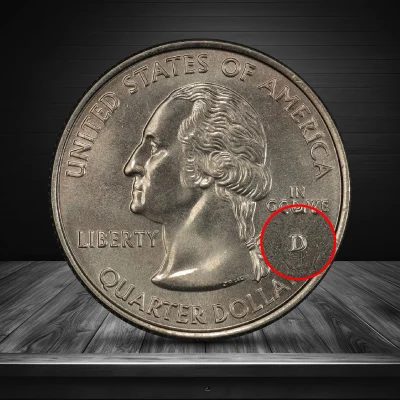
The 2000 Denver-minted (D) state quarters mimic the above Philadelphia issues. D-quarters are also common in circulation because they were struck in large mintages (hundreds of millions per design). In truth, the number of Denver strikes is somewhat fewer than in Philadelphia, in most states, but nevertheless so great as to be regarded in great numbers:
Massachusetts (D): 535,000,000
Maryland (D): 556,532,000
South Carolina (D): 566,224,000
New Hampshire (D): ~496,000,000
Virginia (D): 651,616,000
Therefore, similar to their P-mint counterparts, circulated 2000-D quarters are worth approximately 25c. Uncirculated Denver issues grade and sell in the same ranges: about $3-5 in MS60-MS65. (As an example, the coin value checker explains that the value of all 2000-D quarters, state quarters, are “$3 to $5” through MS 65.) The disparities appear at very high grades.
In MS67, a 2000-D Virginia or New Hampshire quarter is worth ~$40 ,and South Carolina of the same grade is ~$18. The price of MS67 is approximately $25 in Massachusetts.
At MS68, prices shoot through the roof. According to CoinPriceSurvey data, PCGS MS68 2000-D Virginia quarter sells at ~$650 (only 17 PCGS coins of this grade), but a South Carolina is ~$100. A 2000-D Massachusetts in MS69 has sold at auction for about 9,000.
Concisely, a Denver minted 2000 quarter is the same, with circulated pieces worth ~25c, BU in the low MS60s around a few dollars, with only the rare, top quality ones hitting the hundreds or thousands.
Circulated (G-F): ~25cents (face)
Uncirculated (MS60-MS65): ~$3-5
MS67 (certified): -18 to 40 (state-dependent)
MS68 (certified): $100 (SC) to c. $650 (VA)
The collectors are advised to take notice of the mint mark (D on the obverse) and grade. The vast majority of common 2000-D quarters that are sold in the market are either raw (ungraded) coins or slabbed in mid grades. There are only very few coins that reach MS68/MS69, therefore, certified coins have the high value.
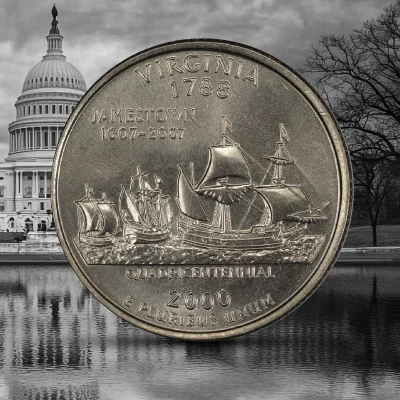
The 2000 Virginia quarter celebrates the 1788 statehood of Virginia, and the Jamestown settlement of 1607. It depicts the three vessels and has Jamestown 16072007 and on the other side Virginia 1788. It is so heavily minted 943,000,000 at Philadelphia, 651,616,000 at Denver 1 that it is very common in circulation. It is 25 cents in everyday grades.
The values are modest in uncirculated (business strike) condition. As a case in point, the 2000-P Virginia quarter is evaluated as approximately $0.72 in MS60 and $4.85 in MS65 by USA Coin Book. The examples of Denver-struck are analogous. These coins sell in average around 1$ to 2$ each in raw (uncertified) BU roll.
Certified high-graded coins are more expensive. An MS67 Virginia quarter of PCGS has a value of nearly forty dollars. There are only a few Virginia quarters which grade MS68; an auction record lists a PCGS MS68 coin selling at ~$650.
The main considerations are as follows:
Over-supply of lots of quantities → low demand → cheap at normal grades.
A premium is only paid on the perfect strikes of Virginia quarters (particularly at MS68/MS69). Also, verify the grade and note additional features (e.g. original mint luster, no contact marks).
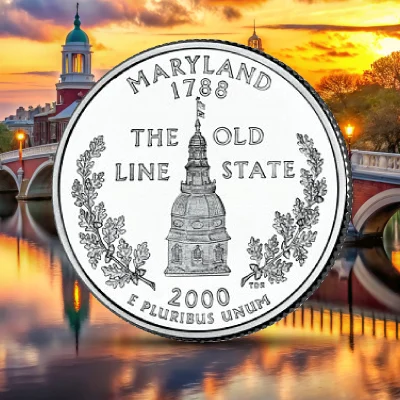
The dome of the Maryland statehouse and the Maryland state banner, taped as, The Old Line State, are the highlights of the 2000 Maryland quarter, which is also written as Maryland 1788. The design is a celebration of the Maryland history (April 28, 1788). Maryland, like Virginia, had very high mintages: 678,200,000 (Philadelphia) and 556,532,000 (Denver). Consequently, the vast majority of Maryland quarters become common pocket change.
Maryland quarters, circulated, are 25c. Uncirculated specimens (mint bags or sets) beg a few more: about 0.75 to 5 according to grade. As a matter of fact, the 2000-P Maryland goes up to a maximum of 4.85 (MS65) and up to 0.72 (MS60) as quoted by USA Coin Book.
Special coins: A couple of Maryland quarters have gone off the wall in auction. Even the MS67 coins (Denver or Philadelphia) bring in only the high tens of dollars. To take an example, a PCGS MS67 Maryland quarter could be worth 30-40 dollars. A PCGS MS68 Maryland quarter (very rare) is roughly $100150 (and there are dozens of them certified (compared to Virginia, which is a lot uncirculated at MS68)).
These coins should be checked by collectors the same way any other coin: sharp strike, complete dome and oak leaf cluster details, clear lettering and no damage after striking. The numeral 1788 cannot as such, outside of a statehood context, be described as anything but the year that Maryland ratified it. Altogether, unless your Maryland quarter has a grade of MS67+, then it is likely to be valued at no more than a few dollars.
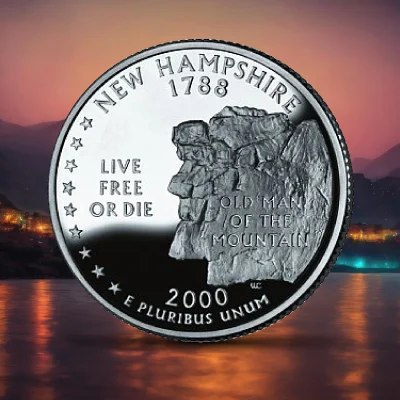
The New Hampshire quarter issued in 2000 has the Old Man of the Mountain rock and the state motto, and it reads New Hampshire 1788. It was struck in large quantities in Denver (496 million) and Philadelphia (673,040,000) in circulation.
Issued: Face (25c). As a matter of fact, the average face value quarter is not worth its face.
Uncirculated: USA Coin Book provides estimates of $0.73 (MS60), $4.91 (MS65) as the values of the 2000-P New Hampshire. The values of Denver mint are similar. As an example, an MS63 raw coin would go on eBay at 3-4 dollars.
Better grades: MS67 New Hampshire quarter may cost about 40 dollars (like Virginia). In New Hampshire, only a small fraction of the quarters is MS68; an MS68 Denver will sell at about the same price as Virginia, i.e. about $650.
Most New Hampshire quarters will remain at face in practice. Seek complete information about the rock carving and visible words of Live Free or Die. Keep in mind that ” 1788″ only denotes that New Hampshire is the 9th state to ratify the Constitution (June 21,1788).
Although 2000 quarters were mass-produced, those with mint errors can be quite valuable and cost a lot more. Some of the most significant errors to look out are:
Generally, the most likely of the 2000 quarters to have any slight value in dollar terms are uncorrected mint errors (off-centers, double dies, clips, etc.). Condition does count, though, and a clean, crisp error coin is preferable to a well circulated one - but an error of any condition will outshine the ordinary coins. Compare the suspect error with examples of the normal options and get it graded when it appears significant. PCGS/NGC usually grades and sells (errors) too. Explore graded Morgan Silver Dollars at BOLD.
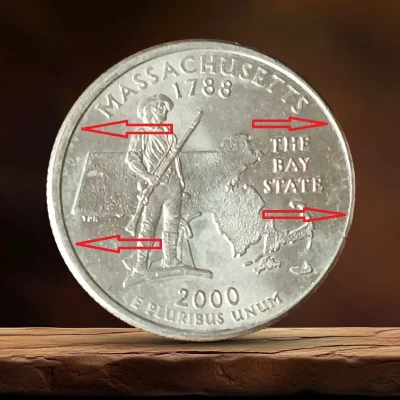
Double die error has duplicated images or text. The double dies are scarce in 2000 quarters. A single known example is a Massachusetts quarter whose hubs are misaligned, though there are not any known doubled-die families like the earlier state quarters.
When they appear, collectors value double dies because the duplication of the legends or state designs is quite dramatic. Be on the lookout of letters that appear shadowed or blurred.
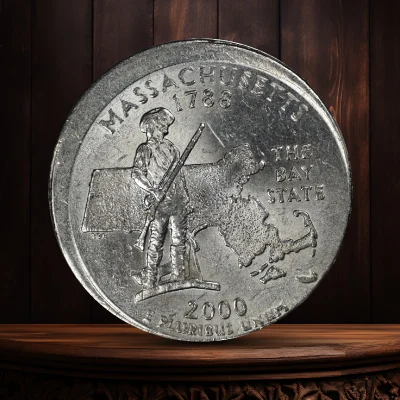
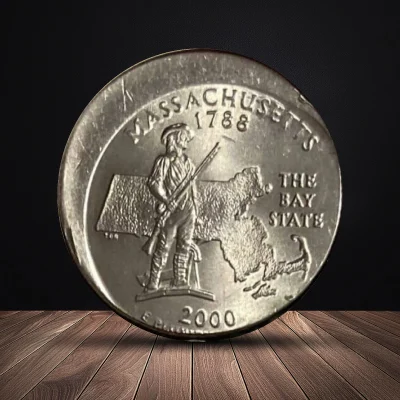
Mis-strike errors occur when the die and planchet do not line up. the more it is off-center the more valuable and rare the coin is. Very small light off-centers (5-10%) might be of high grade worth only $5-20; light off-centers (20%+) are worth $50-200, and very light (30%+) are often a lot more than that.
This can be seen with the $100 sale of the 25% Massachusetts off-center. You always want to look and see whether a portion of design is lost on the rim that is an off center.
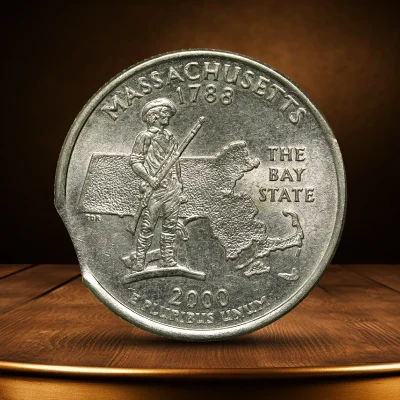
Clipped planchets are those blanks that were clipped or otherwise faulty prior to being struck. When a corner of a quarter is clipped or whole quarter is lacking a portion, it is an error. Minor cuts may be overlooked, but uncut major ones are collectable. It is dependent on the size of the clip (a coin with a small clipped corner would not be worth much, i.e. in the range of 10-30 dollars; a coin with a large portion cut off would be worth a lot more, i.e. between 50 and 100 dollars).
Once more, it depends on the condition. Look again around the rim; you may find a smooth flat place, and that is a clipped planchet.
Sometimes when a struck quarter is stuck again and struck a second time, ghost images are done. A 2000-D Virginia quarter with two strikes (the second one off-centered) is one such example. This coin which has a grade ET64 fetched more than 700 at auction. Multiple struck or multiplied errors are very rare and highly prized by error collectors.
Determining a 2000 quarter’s value starts with grading and ensuring it’s genuine. Here are expert pointers:
Inspect condition: Magnify. Search erosion on elevated surfaces (hair of Washington, the features of the states design). Mint State (MS) mints include fresh luster and no wear. Grade is cut by scratches, bag marks or spots. Look also at luster (shoulder shine). As much as possible, compare with photo grade guides given by PCGS/NGC. A coin with a few marks but still shiny could be AU (About Uncirculated), and be more valuable than a coin that is fully circulated.
Weight and size: Original quarters are 5.67 grams in weight, and 24.3 millimeters across. A quarter weighing substantially more or less, or a smaller or larger one, may be non-standard (clad vs silver proofs, or foreign coin). Take an exact scale in a case of uncertainty. The 2000 state quarters are not silver, they are clad (they are not made of silver), therefore any 2000 marked as solid silver quarter would be a counterfeit or novelty. Check the current silver bars for sale.
Metal test: A test coin 2000 quarter is 91.67 percent copper, 8.33 nickel. It will not fasten itself strongly to a magnet, and its edge will exhibit 119 reeds. (And, if it magnets itself or has an odd edge, assume it is a fake or plated.)
Authentication: High-value coins are best done professionally (PCGS, NGC or ANACS). Encapsulation ensures authenticity and grades grade. Top-dollar pieces should always be purchased in slab or well-verified coins. When purchasing raw coins, do business with reputable dealers. Avoid coins which are too nice (too white, too shiny) because they might be cleaned; toning of the coins is fine.
Referencing grading scales: The contemporary quarter is based on the 1-70 Sheldon grading scale. MS-65 (Gem) refers to a full luster coin with minor contacts. Anything better than MS-65 becomes significantly rare. Your coin is in the low zone of rarity and may have a high premium value, in case it deserves MS67 or more. A second opinion of a coin club or professional may be sought in doubt.
In short:
good strike + original luster + no wear = higher grade = higher value.
Authenticity is key – use weight/magnet tests and buy/sell through trusted sources.
Buy/Sell Venues: The 2000 quarters can be obtained in coin shops, online auction sites (e.g. eBay, CoinZip) or coin shows. The certified coins are selling best, and raw BU coins are selling well in rolls or bulk listings when it comes to selling. To purchase, most ungraded 2000 quarters come in bags or rolls.
Seek packaging: This is a fantastic find: New mint rolls, Mint Sets or Proof Sets. A 2000-D Mint Roll of 40 quarters (uncirculated) might fetch 15-20 dollars in the current market (or even 50 cents each), which is much more than 40 loose cents. The 2000-P quarter has a mint price of 1-2 in original mint cell (Mint sets).
Avoid usual pitfalls: A lot of 50c Junk sacks sell off cheap quarter rolls, however, discard any used/grubby ones. Coins that have been washed or otherwise scarred do not command much premium. Watch out, too, on the so-called enhanced or plated quarters that are sold as valuable, they are fake numismatics.
Networking: Meet other people who collect state quarters by becoming a member of coin clubs or coin forums on the Internet. Members tend to share spotting guides, give error finds and even exchange. The major varieties can be identified with the help of such books as the Cherrypicker Guide to Errors and Varieties.
Insurance and storage: In case you accumulate highly valuable quarters, you should store them in airtight holders or albums, and you can take out insurance against a treasured collection. Consider a Precious Metals IRA for tax-advantaged holdings.
Basically, find the most well-struck 2000 quarters available and never fail to check weight and condition. Some seriousness will make you get good deals and without counterfeits.
The 2000 issues are not especially rare and special in the context of the whole 50 State Quarters Program. The vast majority of state quarters minted during the 19992008 period were struck in hundreds of millions of pieces, and thus are prevalent in lower grades. Modern state quarters are only worth face value except where it is an uncirculated or an error.
The quarter values of 2000 follow the same trend as all the other years: face in the circulated realm, low premiums in the BU realm, and rare finds (errors or MS68+) only break those standards. Not one of the 2000 state quarters (other than the grade extremities) is a standout among the others.
Indeed, the most valuable 2000 quarter in the grade has ever been an error/grade outlier (the MS69 Massachusetts at ~$9k); otherwise, most of the 2000 issues are firmly ensconced in the mire of the common series. Therefore, consider 2000 quarters to be like regular state quarters. For precious metals pricing, see the gold bars for sale, not hard to find and collect by any collector but rather abundantly available with many designs.
To put it in perspective, other series (such as the 2009 DC & Territories quarters) were very lightly minted and are of greater interest. The combined mintage of the 2000 coins was one of the highest of the program (more than 1.5 billion in Virginia alone).
In short, grade and any special characteristics influence the 2000 quarter value practically completely. The majority of the examples struck at Massachusetts, Maryland, South Carolina, New Hampshire and Virginia were so numerous that the common coins bear no more than face value.
Uncirculated mint-state quarters are readily available to a few dollars but only genuine rarities (perfectly graded MS69 or mint errors) achieve high prices. The keys for collectors are familiarity with mintages. If you are interested in precious metals investment, explore gold bullion at BOLD (all states produced in 2000 had mintages that ran 5 to 9 hundred-million), grading and seeking errors.
The majority of state quarters of 2000 have a face value (in circulated state) of $0.25. A normal 2000 quarter could be worth a few dollars in uncirculated grades. An MS60 may be well under $1 and an MS65 about $4-5 (example). Only very high grade or error specimens command much more.
The pattern holds with a 2000-D (Denver mint) quarter, which, were it circulating, would be worth about 25c. 2000-D quarters are about 3-5 dollars MS60-MS65 in uncirculated condition. Certified (MS67+) specimens are rare and can be worth between 20 to 650+ in value, depending on the state and grade. Concisely, a 2000-D quarter will only be worth more than face value when it is in mint condition or it has a mint.
No, not on the whole. The state quarters with 2000 mintages were in the hundreds of millions; thus the state quarters are common. Off-market, most of them can be easily located at face value. The rare ones are error coins, or, exceptionally, the surviving grade-68/69 ones. According to coin experts, the average circulated state quarter has a value of $0.25, which is the face value. Therefore, 2000 quarters are plentiful, similar to many other state quarters.
As a rule, ordinary quarters of 2000 are not of premium. The exceptions that do have value are: rare high-grade coins or errors, the ones worth money. An example is the best-known 2000 quarter, the Massachusetts, which was struck in Denver and graded PCGS MS69, and is valued at about $9,000. An MS68 2000-D Virginia or New Hampshire sells at about $650. Off-center or double-struck error coins (any state) have brought hundreds of dollars. However, a random 2000 quarter out of change is generally only worth 25c to 1$ unless at a higher grade than MS67+.
The 2000 quarter is showing the date "1788". This is the year the state joined the Union. For instance, New Hampshire ratified the Constitution in 1788 (the 9th state), Maryland in 1788 (the 7th state), and Virginia in 1788 (the 10th state). The quarters bear the name of the state, the year 178,8, and usually a motto (such as the Live Free or Die of New Hampshire). It has nothing to do with the coin's mint date; it's the story.


Affiliations


Copyright BOLD Precious Metals 2026