Due to their versatility, gold coins have historically been popular choices among investors. Coins draw investors and collectors and offer diversification to any investment portfolio, in contrast to gold bars or ingots, which are usually sought after because of their cheaper production costs. In contrast to a gold bar, which offers just one selling chance, gold coins offer many opportunities for selling all or some of your gold at various weights and price points, allowing you to easily sell exactly how much you wish. Due to the long history of gold bullion coins, there is a huge and interesting market to explore.
Given the wide variety of gold coin options, people often find navigating the world of gold coins tricky. This guide will share the best options for your investing needs by explaining the differences between different types of gold coins.

Gold first emerged in its natural state in rivers all over the globe. Certainly, it was the first metal that early humans became aware of. After that, gold became an integral aspect of every human civilization. It was enjoyable to work with and play with because of its brilliance, luster, and natural beauty, as well as its exceptional malleability and resistance to tarnishing.
When we look into the historical evolution of technology, we believe the creation of iron and copper to be the primary contributors to our civilization's economic and cultural success - although gold arrived first. Early civilizations associated gold with gods and kings, and gold was sought after in their honor and used to glorify them. As a result, humans almost automatically place a high value on gold, associating it with the cultural elite, power, and beauty. Due to the widespread accessibility of gold, both ancient and contemporary civilizations worldwide have similar opinions about metal.
Because gold can be found across the geologic world, its discovery went on to many separate communities in several places. Around 700 B.C., Lydian traders from what is now western Turkey created the first coins, marking the beginning of using gold as money. These were merely stamped chunks of a 63% gold/27% silver alloy known as 'electrum.'
As coinage proliferated, civilizations struck gold coins with images of their gods, goddesses, or kings and queens. Gold aureus coins from ancient Rome were used as money, and throughout the Middle Ages, European nations like England, France, and Italy produced gold coins like the gold florin, noble, and ducat. Gold coins like the South African Krugerrand, British Gold Sovereign, and American Gold Eagle have recently gained prominence among investors and collectors.
For those investing in gold coins, knowing the background of gold coins and the types of gold coins is important because it helps them appreciate the beautiful craftsmanship and cultural heritage they stand for.
Gold coins offer great investment options for investors who value the historical worth of gold. However, if you want more than a financial investment, coins are for you. In fact, you can even start a coin collection. Here are some types of gold coins:
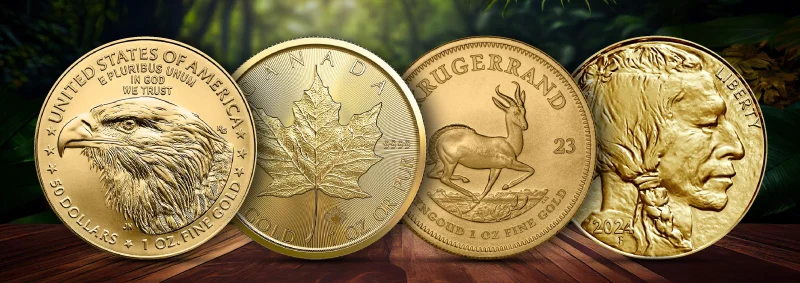
Bullion coins are struck primarily for investment purposes, and their worth depends on their solid gold content and the market price of the precious metal. Therefore, gold bullion coins like the Gold Britannia are preferred by investors due to their high gold content and purity (generally 22 to 24 carats).
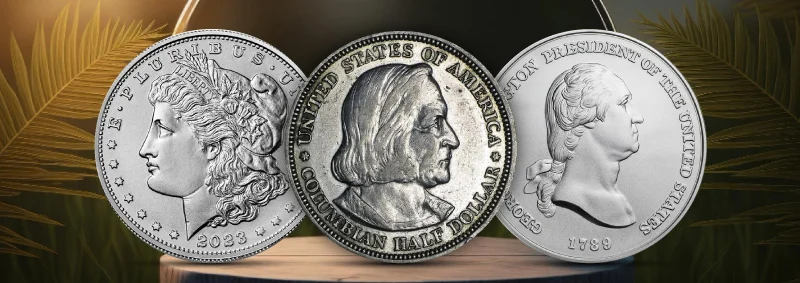
Commemorative coins commemorate specific events, anniversaries, or significant people, and they often feature complex designs and a limited mintage. Aside from their gold content, these coins are typically more valuable to collectors than investors because of their limited supply and antiquity. For instance, the Memorial Gold Sovereign celebrates the coronation of King Charles III and the end of Queen Elizabeth's reign.
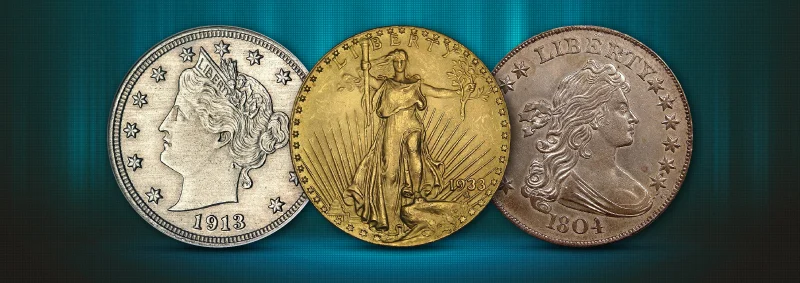
Rare or historically noteworthy numismatic coins are collected for reasons other than their precious metal content. Due to its rarity and collectibility, these coins often fetch higher premiums. Numismatic gold coin investment is a more specialized and highly lucrative investment for seasoned collectors since it needs an in-depth knowledge of the market and the capacity to properly assess a coin's worth in value.
Investing in gold coins can have a number of benefits under the right conditions.
Purchase power falls as prices rise due to inflation. As a result, if you have cash, you are actually losing money. On the contrary, gold is often thought of as an inflation hedge. This is because the price of gold may rise when the value of the dollar declines (and so do the gold bullion coins).
Some investors purchase gold coins to diversify their portfolios. Spreading your capital over various investments instead of being totally invested in a single asset class can help you better manage both risk and return. Gold, or other precious metals, can make sense in a well-balanced portfolio with the proper allocation.
Unlike a gold bar, gold coins can be sold as fractional gold. You can not cut a small portion of your 5 kg gold bar to sell. You must sell the entire metal, and your chance to use the market conditions to your benefit is limited. But, gold coins come in fractional sizes. You can scale your selling amount as per your needs. You can take full advantage of the metal market and profit considerably. Moreover, coins allow you to sell your products above the market price for having antique value and other design-specific reasons (significance, limited mintage, and scarcity).
While all these benefits, buying gold coins online comes with certain drawbacks.
Proper handling is a must. Poorly conditioned coins lose their market value. Improper storage leads to damage over time due to environmental factors. Moreover, reckless handling can lead to decaying design excellence, further decreasing the value.
Compared to gold bullion Bars, gold coins come with higher premiums due to their intricate designs and production expenses. Therefore, when you buy coins for investment purposes, you have to pay higher premiums on the actual market value of the metal.
Finding the right buyer at the right time for gold coins can be difficult. For example, you may not find an investor with an interest in antiquity and aesthetics or seasoned collectors when the market value for gold is upsurging or vice versa.
A gold bar is, simply put, a chunk of metal. It is, however, a little more refined than that because it is often designed into a clean cuboid shape with the weight and purity of the equal gold content written on the surface. This is advantageous for investors who want gold for its intrinsic value; however, a gold bullion coin has a premium value due to its rarity, and it can sometimes be legal money and many people focus on historical and traditional coinage. There are a lot of gold coins that are still sold today that were originally used as money. Here are some pointers for gold coins vs. bars:
Size: Gold coins usually come in not more than 1 ounce size with a cylindrical shape, while gold bars are made in a variety of sizes, with 5kg and 10 kg being the most popular. Bars mostly come in blocks with various geometric angles.
Ease of Storage: Gold coins need special storage conditions to preserve their qualities. The best option is for high-end coin envelopes or albums to be placed in properly regulated vaults or lockers. On the other hand, gold bullion bars need minimal care while handling. As a result, they can be easily stored in bank vaults or with high-security locks at home.
Cost: Gold bars have lesser premiums than gold coins because coins are struck with special designs while gold bars hardly feature any intricate details other than security features. It means one can buy more quantity of gold in the form of bars for the same price than that in the form of gold coins.
Historical/Traditional Value: As said already, coins come with historical and traditional value, unlike bars. Bars are solely designed for investment purposes, while coins also have collectible features apart from investment qualities. The antiquity of coins, special mintage editions, designs, and the occasion of release to add more value to the coins and their metal content.
It's time to make a choice on how you will proceed if you wish to invest in the gold market. Or, more precisely, what kind of gold you want to buy. Considering all the pros and cons, if you choose gold bullion coins, the first step in your investment or collection journey is to find a reliable seller that offers a premium range of gold coins online. BOLD Precious Metal is the most reliable dealer of precious metals, and on its website, you can find an impressive range of gold coins from prominent mints across the globe. So, find your ideal types of gold coins and start investing in gold coins today.



Affiliations


Copyright BOLD Precious Metals 2026