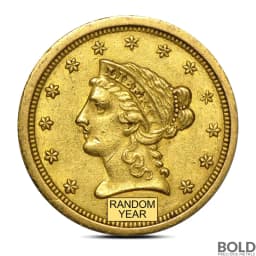
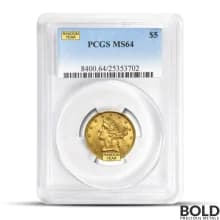
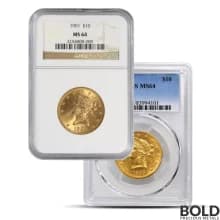
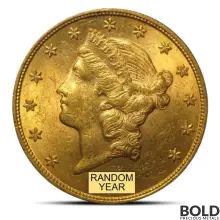
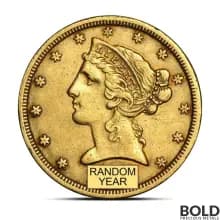
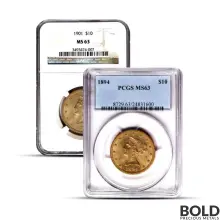
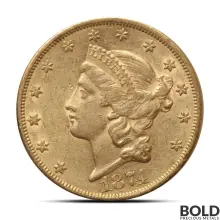
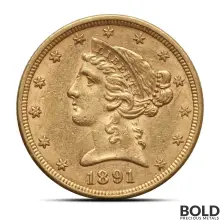
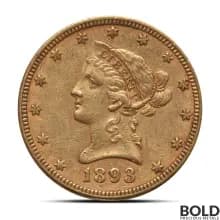
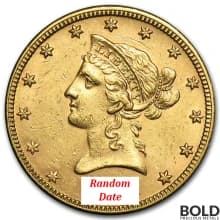
Take home a physical part of American history through our sourced collection of Pre-1933 Liberty Gold Coins. Stamped in a period of national growth like never before, between the California Gold Rush and the beginning of the 20th century, each Liberty gold coin is an unbroken connection to the economic roots of the United States. These old coins were used in circulation as legal tender, driving the economy forward and demonstrating the increasing prosperity of the country.


$10 Liberty Gold Eagle Coin (VF)
Out of Stock

Liberty Gold Coins were issued across four denominations, each with its own gold content, mintage history, and buyer profile. Unlike a single bullion product with one price point, this series gives you genuine flexibility — from a sub-$400 entry point with the Quarter Eagle to near-one-ounce gold exposure with the Double Eagle. Browse the full for live inventory across all four denominations.
| Denomination | Face Value | Gold Content | Composition | Struck | Designer |
|---|---|---|---|---|---|
| Liberty Quarter Eagle | $2.50 | 0.1209 oz | 90% Gold, 10% Copper | 1840–1907 | Christian Gobrecht |
| Liberty Half Eagle | $5.00 | 0.2419 oz | 90% Gold, 10% Copper | 1839–1908 | Christian Gobrecht |
| Liberty Eagle | $10.00 | 0.4837 oz | 90% Gold, 10% Copper | 1838–1907 | Christian Gobrecht |
| Liberty Double Eagle | $20.00 | 0.9675 oz | 90% Gold, 10% Copper | 1850–1907 | James B. Longacre |
Key Legal Fact
All four denominations were struck in 90% fine gold — the same constitutional alloy used in every U.S. gold coin before President Roosevelt's 1933 Executive Order 6102 removed gold from circulation. Pre-1933 Liberty Gold Coins hold a distinct regulatory status compared to modern bullion, and in many states they carry sales tax exemptions that generic gold bars do not.
The Most Liquid Pre-1933 Coin in the World
The $20 Liberty Double Eagle is the most liquid Pre-1933 gold coin in the world. Full stop. When gold runs, these move faster than any other Pre-1933 issue — dealers, institutions, and sophisticated collectors all know the Double Eagle. Type 2 and Type 3 Coronet examples (1866–1907) are especially active, with tight bid-ask spreads in VF through AU grades. If you're buying for investment liquidity first, the Double Eagle is your entry point.
The Sleeper of the Series
Here's the insight most buyers won't find elsewhere: the Half Eagle ($5) is the sleeper of the series. In circulated grades, it trades at a lower premium over spot than a comparable Double Eagle, yet carries identical historical pedigree and the same Pre-1933 regulatory advantages. For a first-time buyer who wants real Pre-1933 gold without the $2,000+ ticket of a Double Eagle, the Half Eagle is where I'd start every time.
Mintmarks Matter More Than You Think
Carson City (CC) examples consistently command premiums above comparable Philadelphia strikes — particularly on Half Eagles and Eagles. If you're seeing two VF35 examples at similar prices and one is a Carson City issue, that's not a coin to pass on.
Grade is the single largest variable in Liberty Gold Coin pricing — a $20 Double Eagle in VF30 and the same coin in MS63 can differ by $1,500 or more. Matching grade to your buying goal is the most important decision you'll make.
| Grade Range | Description | Best For | Premium Over Spot |
|---|---|---|---|
| VF20–VF35 | Clear design, visible wear on high points, date fully readable | Bullion-focused buyers, first purchase, maximum gold per dollar | Lowest |
| EF40–AU50 | Minimal wear, most design detail intact, some luster in fields | Balanced collector/investor — best value in the series | Moderate |
| AU55–AU58 | Trace wear on highest points only, strong luster, near-mint appearance | Condition-focused collectors, long-hold positions | Higher |
| MS60–MS63 | No wear, full mint luster, certified by PCGS or NGC | Numismatic premium buyers, registry collectors, 10+ year holds | Significant |
Ryan's Rule — Grade Strategy
For pure gold exposure with Pre-1933 cost efficiency, buy VF to EF grades you get the historical significance, the regulatory advantages, and the real gold weight without overpaying for surface quality.
For coins you intend to hold for 10 years or longer with appreciation potential beyond gold's spot price, step up to AU58 or MS63 PCGS/NGC certified pieces. Grading-service certification removes buyer hesitation on resale and tightens the bid-ask spread significantly.
| Denomination | Gold Content | Why Buy It | Best For |
|---|---|---|---|
| $2.50 Quarter Eagle | 0.1209 oz | Lowest entry price in the series; easiest to gift or stack in smaller increments | New buyers, gift buyers, budget-conscious collectors |
| $5 Half Eagle | 0.2419 oz | Best value-to-history ratio in the series; lower numismatic premium than Double Eagles in circulated grades | First-time Pre-1933 buyers, investors diversifying from modern bullion |
| $10 Eagle | 0.4837 oz | Half the gold of a Double Eagle at a lower per-coin numismatic premium; less common in raw form | Mid-range investors who want bulk gold weight without Double Eagle price points |
| $20 Double Eagle | 0.9675 oz | Most liquid, most recognized, most prestigious Pre-1933 gold coin — tightest bid-ask spread on resale | Serious investors, portfolio hedgers, experienced collectors |
The smallest and most accessible denomination. Struck at Philadelphia, New Orleans, San Francisco, and Denver mints — particularly popular as gifts and series entry points. Look for VF–EF examples for best value; the 1848 CAL. overprint commands significant premiums.
Ryan's personal recommendation for first-time Pre-1933 buyers. Circulated VF35–EF45 examples routinely offer the tightest premium over spot in the entire Pre-1933 gold category. Carson City and New Orleans issues add numismatic interest.
The overlooked middle child — and a genuine buying opportunity. Nearly half an ounce of gold, yet the per-ounce numismatic premium in circulated grades often runs below comparable Double Eagles. Surviving EF or better examples are genuinely harder to find in volume.
The benchmark Pre-1933 gold coin for investors worldwide. Type 1 (1850–1866), Type 2 (1866–1876), and Type 3 (1876–1907) variants each have distinct collector markets. Type 3 circulated examples offer the deepest liquidity; Type 1 AU55+ pieces carry the most numismatic appreciation potential.
Every Liberty Gold Coin carries a premium above its raw gold melt value. That premium is built from four components:
Numismatic Demand
Collector and investor interest in historically significant U.S. coinage drives premiums above raw gold weight.
Limited Surviving Supply
The 1933 recall and subsequent melting removed a large portion of the original mintage — permanently reducing supply.
Date & Mintmark Desirability
Collector demand by specific date and mint facility creates pricing tiers within each denomination.
PCGS / NGC Certification
For certified coins, the cost and credibility of grading-service authentication adds a resale confidence premium.
Market Dynamics Insight
In rising gold price environments, circulated Liberty Gold Coins tend to compress their premium spread to spot — bullion buyers flood the market seeking any form of authenticated Pre-1933 gold, and common-date VF examples get absorbed quickly at prices approaching melt. In flat or declining gold markets, the numismatic floor on AU and MS examples provides a price cushion that pure bullion products do not carry. Owning a mix of grades gives you exposure to both dynamics.
Legal Distinction
The U.S. government's 1933 gold confiscation order (Executive Order 6102) explicitly exempted coins of recognized numismatic value. Pre-1933 Liberty Gold Coins have held that status continuously since issuance — a legal distinction with practical implications for U.S. buyers that modern gold bars and rounds do not share.
Overlooked Fact: Branch Mint Premiums
The U.S. Mint operated multiple branch facilities during the Liberty Gold era — Philadelphia (no mintmark), New Orleans (O), Carson City (CC), San Francisco (S), and briefly Denver (D). Philadelphia produced the largest volumes; Carson City the smallest.
Carson City (CC)
Lowest original mintages of any facility. A Carson City Half Eagle or Eagle in comparable grade to a Philadelphia example will almost always carry a higher resale premium — often 15–30% above the Philadelphia counterpart.
New Orleans (O) & San Francisco (S)
Both command collector interest above Philadelphia strikes. S-mint examples are especially active in higher grades due to California's gold rush–era production volumes and distinct die characteristics.
Buyer Note
When you're browsing BOLD's live inventory, the mintmark in the product title is not decorative — it's a direct pricing variable worth understanding before you buy. Two VF35 coins at similar prices with different mintmarks are not the same coin.
Yes — with context. Liberty Gold Coins combine real gold content (90% fine, measured in troy ounces) with a numismatic floor that modern bullion lacks. Common-date circulated examples track gold spot price closely. Higher-grade and key-date examples carry appreciation potential independent of gold price movement. For buyers who want gold exposure plus historical asset diversification, Liberty Coins are one of the most defensible positions in the Pre-1933 category.
Both are $20 U.S. gold coins at 0.9675 troy ounces, but they are entirely different designs. The Liberty (Coronet) Double Eagle features the classic Coronet head designed by James B. Longacre, struck 1850–1907. The Saint-Gaudens Double Eagle features Augustus Saint-Gaudens' iconic striding Liberty design, struck 1907–1933. Saint-Gaudens examples consistently carry higher numismatic premiums due to their artistic prestige. Liberty examples are more available in circulated grades at closer-to-spot pricing. Both are genuine Pre-1933 gold with the same legal and regulatory status.
Selected Pre-1933 Liberty Gold Coins do qualify for inclusion in a self-directed Gold IRA under the legal tender exemption as original U.S. Mint issues. However, IRA custodians vary in which specific coins and grades they will accept. Visit BOLD's Precious Metals IRA page for IRA-specific inventory guidance, and consult your custodian before purchasing for account inclusion.
For a first purchase, VF35 to EF45 in a common date Half Eagle or Double Eagle is the recommended starting point. You get genuine Pre-1933 gold at the most efficient price-per-ounce in the series, a coin with enough design detail to be attractive in hand, and an asset that is easy to sell when the time comes. Avoid raw AU and MS examples until you've spent time understanding the grade-to-price relationship — the premium jump from EF to AU is significant and not always justified for an investment-first buyer.
Weight and diameter are your first checks: Quarter Eagle (4.18g / 18mm), Half Eagle (8.36g / 21.6mm), Eagle (16.72g / 27mm), Double Eagle (33.44g / 34mm). Beyond spec verification, PCGS and NGC certification is the gold standard for authentication — both services slab and grade coins with serial-numbered holders that can be verified online. At BOLD, all raw coins are sourced from verified channels and all certified examples carry valid PCGS or NGC holder guarantees.
Value depends on denomination, date, mintmark, and grade. Common-date circulated examples start near gold melt value plus a modest numismatic premium — typically 10–30% over spot for VF–EF grades. Key dates and certified MS examples can trade at multiples of melt. The most accurate way to assess current value is to check BOLD's live inventory pricing, which reflects real-time market conditions.


Affiliations


Copyright BOLD Precious Metals 2026