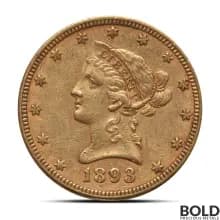
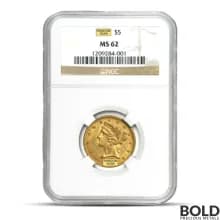
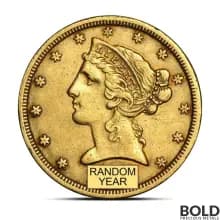
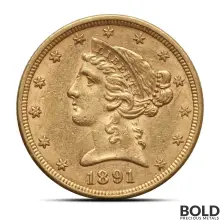
Take home a physical part of American history through our sourced collection of Pre-1933 Liberty Gold Coins. Stamped in a period of national growth like never before, between the California Gold Rush and the beginning of the 20th century, each Liberty gold coin is an unbroken connection to the economic roots of the United States. These old coins were used in circulation as legal tender, driving the economy forward and demonstrating the increasing prosperity of the country.
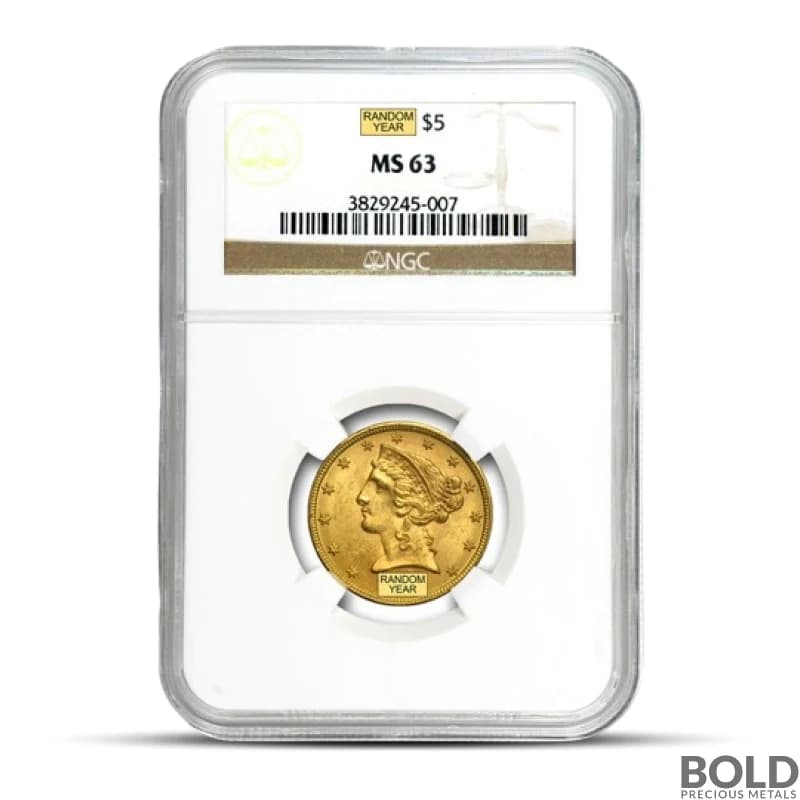

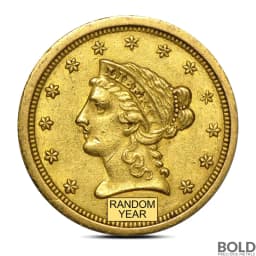
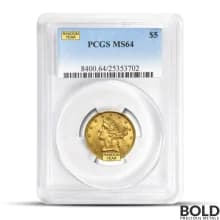
$5 Liberty Gold Half Eagle Coin (MS63, NGC or PCGS, Random)
In Stock
AS LOW AS
$1,216.35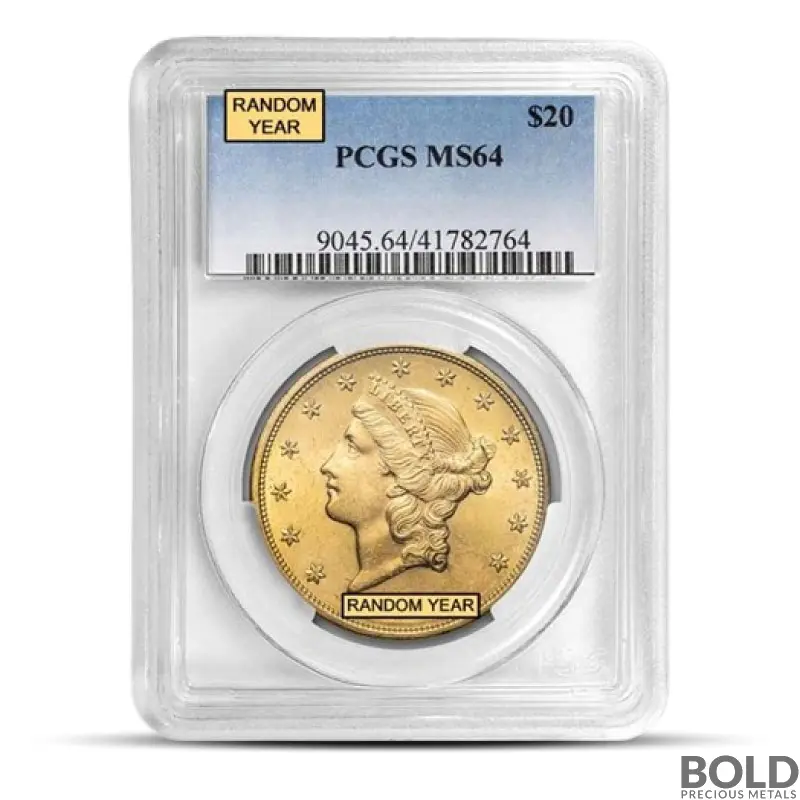

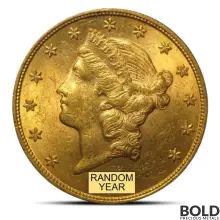
$20 Liberty Double Eagle Gold Coin (MS64, NGC or PCGS)
In Stock
AS LOW AS
$4,586.34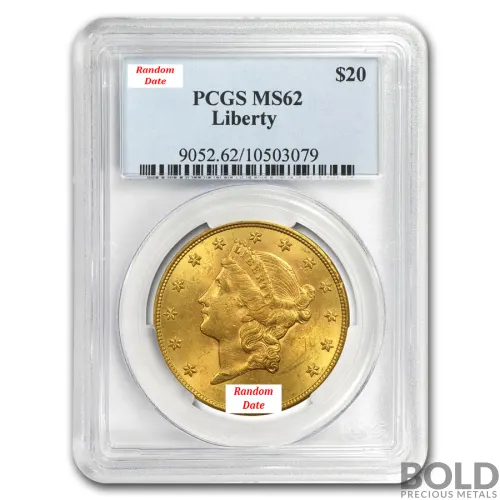

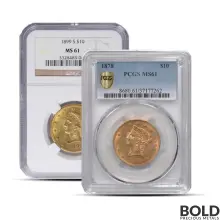
Gold $20 Liberty Double Eagle NGC/PCGS Graded Coin (MS62)
In Stock
AS LOW AS
$4,479.91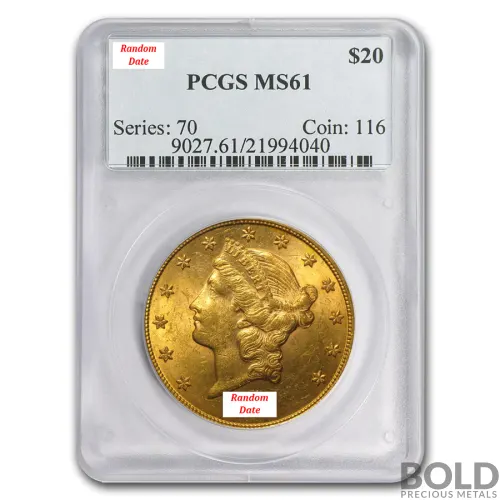

Gold $20 Liberty Double Eagle NGC/PCGS Graded Coin (MS61)
In Stock
AS LOW AS
$4,479.91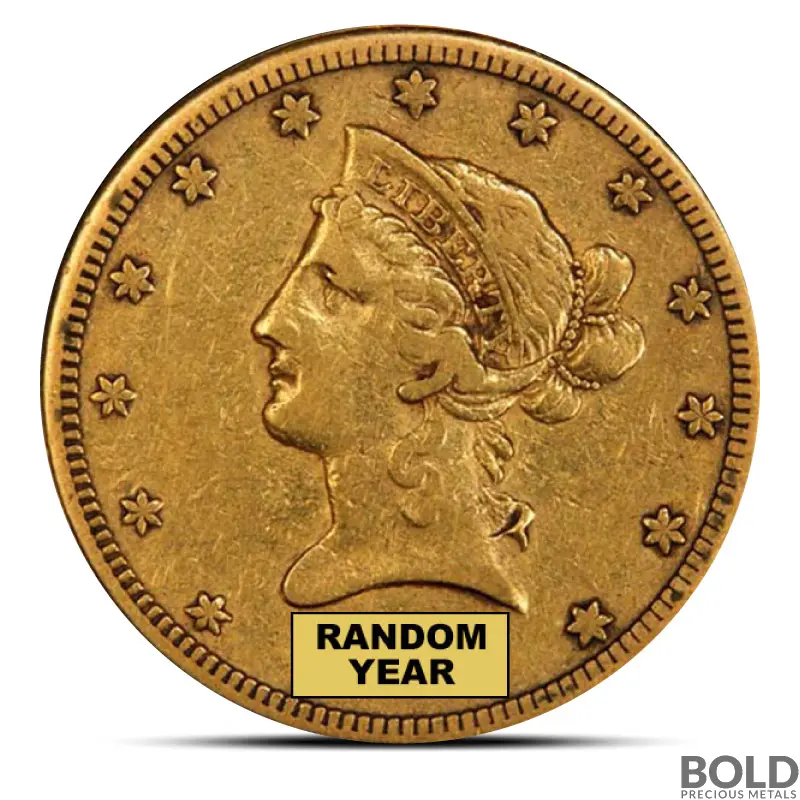

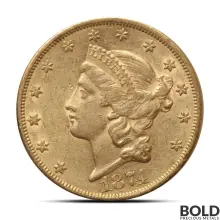
$10 Liberty Gold Eagle Coin (VF)
Out of Stock
The Liberty Head series, or the Coronet Head, is one of the most well-known and longest-lived chapters in American coinage. These gold coins, which were created in four different denominations, were the workhorse of the U.S. economy spanning a 7-decade life span. These sections will present an overview of each type of coin in more detail, including some basic specifications and historical background information to help coin collectors and investors.
| Denomination | Nickname | Years Minted | Designer | Gold Content (Troy Oz) | Gross Weight (grams) | Diameter (mm) |
|---|---|---|---|---|---|---|
| $20 | Double Eagle | 1849–1907 | James B. Longacre | 0.9675 oz | 33.436 g | 34 mm |
| $10 | Eagle | 1838–1907 | Christian Gobrecht | 0.4837 oz | 16.718 g | 27 mm |
| $5 | Half Eagle | 1839–1908 | Christian Gobrecht | 0.2419 oz | 8.359 g | 21.6 mm |
| $2.50 | Quarter Eagle | 1840–1907 | Christian Gobrecht | 0.1209 oz | 4.18 g | 18 mm |
The most widely known and most imposing of all American vintage gold coins is the $20 Liberty Head, or Double Eagle. It was created specifically because of the California Gold Rush, which left a requirement in the denomination of a high-value coin to transform the enormous amount of gold into something that could be banked and traded.
Chief Engraver James B. Longacre designed the obverse and is encased with a Greco-Roman inspired bust of Lady Liberty, and the reverse features a mighty heraldic eagle. It weighed almost a full troy ounce (0.9675 oz) of pure gold and was one of the foundations of American finance. The series is classified into three subtypes, which are differentiated by alteration of the reverse:
Type 1 (1849–1866): Motto is IN GOD We TRUST.
Type 2 (1866–1876): A ribbon was added to the motto over the eagle.
Type 3 (1877–1907): This was the denomination spelled out in full, "TWENTY DOLLARS" rather than “TWENTY D”.
The Liberty Head Eagle of $10 was another coin to cause the re-entry of the ten dollar gold coin into the market, after 34 years of absence. Christian Gobrecht did the new design and his motif of the Coronet Liberty would become the standard of the U.S. Mint U.S. gold coins of the day. An old-style bust of Liberty in a coronet prevailed on the obverse, and on the reverse, we have a proud heraldic eagle. Two major types of the series are well known:
No Motto (1838–1866): Before the motto was required by Congress the early issues were struck.
Motto (1866–1907): IN GOD WE TRUST. A scroll containing the motto was put above the eagle on the reverse.
The Liberty Head Quarter Eagle was the smallest denomination in the Coronet series and used in the daily operations. It was also designed by Christian Gobrecht, and introduced the unified look of gold coinage in the U.S. The coin's pure gold weighs 0.1209 troy ounces. Only the larger denominations added the motto IN GOD We Trust in 1866, but the small size of the Quarter Eagle was considered prohibitive to the change.
As a result, it became the single coin in the sequence that was made during its 67-year existence which never had a reverse design containing the motto.
The purchase of Pre-1933 liberty gold coins is an investment in history, rarity and art. Learning the most important aspects that define value is the way to purchase without doubts.
All liberty gold is worth a certain amount of gold, commonly referred to as its melt value. But its ultimate market price is the premium of its numismatic value. This is a premium that is driven by rarity (date and mintmark) and condition (grade) and collector demand. A common-date coin in circulated condition could sell at close to its gold value and a rare-date coin in pristine condition might sell at an exponentially greater price.
The industry has adopted third-party grading services like the Professional Coin Grading Service (PCGS) and the Numismatic Guaranty Corporation (NGC) as a way to assure the buyer of their purchase. Such services verify every coin and give it an exact grade. By buying a certified coin the coin ensures its authenticity, offers a universal standard of quality and also increases its liquidity in the market.
A: The price is calculated by two primary factors: the base value which is its gold content and its numismatic value which is calculated as per its rarity, condition (grade) and collector demand. Common coins may sell at slightly above or slightly below the price of gold. Larger, high-grade coins may go for many thousands of dollars.
A: They are regarded by many as an excellent investment, as the numismatic value gives them a chance to appreciate over time, and they provide the safety of a physical gold investment. There is a limited amount of these historic coins that can ever be issued, and therefore with an increase in collector demand, the value of the rarest coins will tend to go up.
A: 0.9675 troy ounces of pure gold is in a $20 Liberty Head Double Eagle. The coin is produced in a blend of 90 percent gold or copper and 10 percent of both to give it durability.
A: Rarity and condition are the basis of price difference. Virtually any coin of a low mintage or of some historic mint, such as Carson City (CC), is considerably more rare than an ordinary coin of Philadelphia. Similarly, a coin in its pristine uncirculated state will be much rarer than one that is highly worn, and it will be more expensive due to its rarity.


Affiliations


Copyright BOLD Precious Metals 2026